
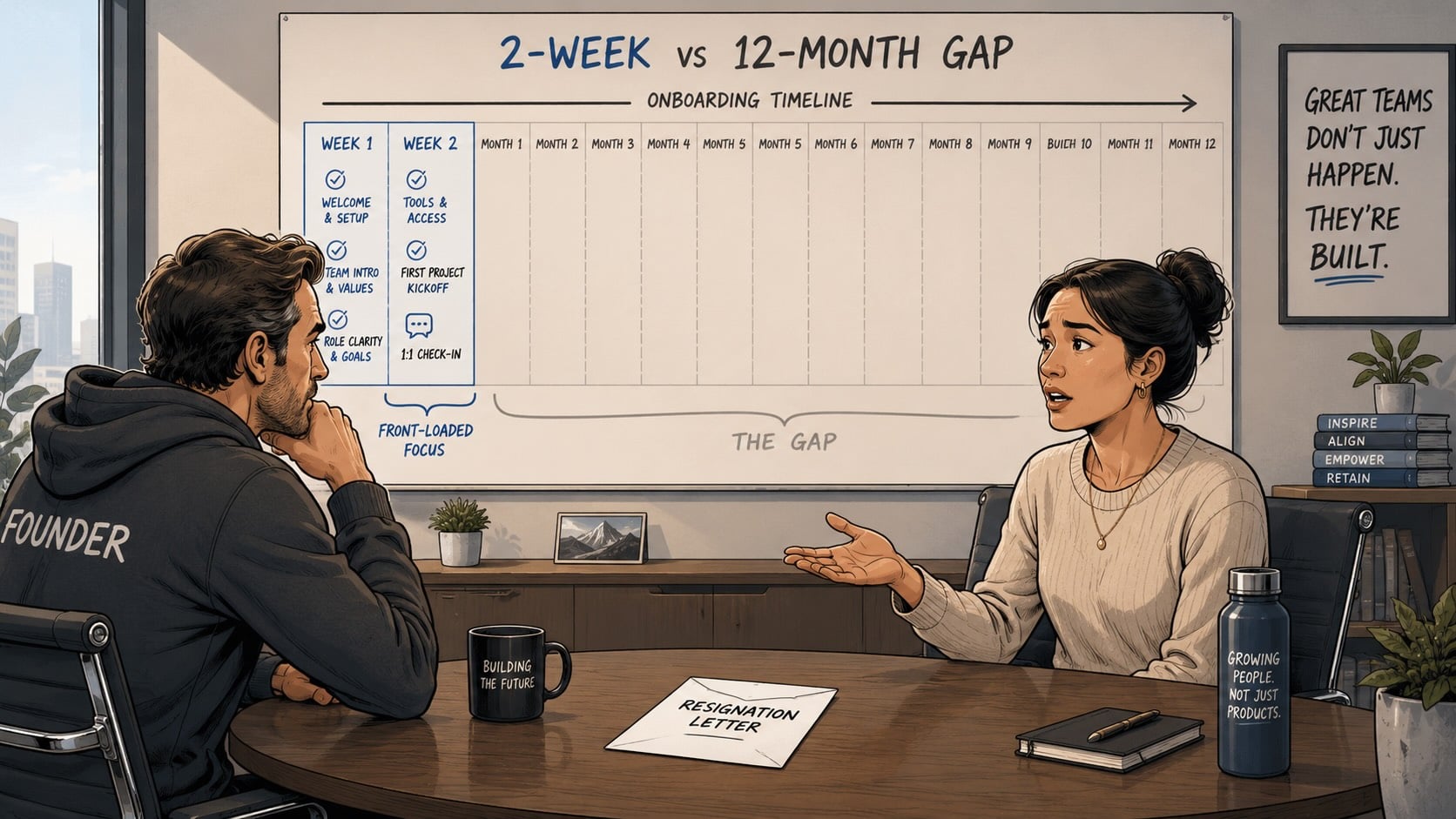

QUICK SUMMARY: Most companies treat onboarding as a two-week event, but employees decide whether to stay within their first 90 days and the highest-risk exit window is months 3–6. A 12-month onboarding system — a written role charter, a checkpoint calendar (Day 1, Day 30, Day 60, Day 90, Month 6, Month 12), and a structured 30-day check-in script — closes that gap. The right system scales with headcount: presence alone at 1–3 people, a written 1-pager and monthly check-ins at 4–8, and a full 12-month employee onboarding framework with an integration buddy at 10–25.
You spent 11 weeks finding this hire. Four months later, they’re across the table telling you they found something else.
The first week went fine. You set them up, made introductions, walked them through the tools. By week two they were “up and running.” One check-in in month two. Nothing seemed wrong.
Nothing about that hire was bad. The onboarding around them was broken.
Most companies treat onboarding as a two-week HR event: paperwork, laptop, team lunch. But employees decide whether to stay within their first 90 days. A two-week checklist doesn’t reach that far.
Operators who keep people build a 12-month system instead. It’s not complicated, but it means treating onboarding as a structured calendar with checkpoints that catch drift before it becomes a resignation. Here’s the playbook.
What Is a 12-Month Onboarding Integration?
A 12-month onboarding system is a structured calendar of conversations and checkpoints running from Day 1 through the end of a new hire’s first year, not a one-time checklist.
A two-week model gives you orientation. It doesn’t give you clarity, connection, or growth signal — the three things that actually keep someone past month four.
- Days 1-30: Orientation and early wins. A written role charter and a real task, not busywork.
- Days 31-90: Role clarity and culture anchor. Structured check-ins with written feedback.
- Months 4-6: Performance calibration — the danger window most companies go silent in. The same silent-drift dynamic shows up at the top of the org too, in how founders decide when a role has genuinely outgrown them.
- Months 7-12: Growth signal. You’ve answered the hire’s unspoken question: “Is there a future for me here?”
It’s a familiar pattern: a clean two-week onboarding, followed by a resignation in month four or five. The checklist wasn’t wrong. It simply didn’t cover enough of the year.
The Real Cost of Getting Onboarding Wrong
Real Numbers: The Cost of a Failed Hire
- Recruiting and hiring cost: $5,000–$25,000
- Lost productivity during vacancy: 1.5x to 2x annual salary
- Time before a replacement reaches full output: 6-9 months
- All-in cost of a failed $60K hire: $50,000–$120,000
- All-in cost of a failed $100K hire: $80,000–$200,000
- At a 10-person company: one failed senior hire can equal 15–20% of annual revenue
At under $5M revenue, a $100K failed hire isn’t an HR statistic. It’s a cash flow event.
The financial hit isn’t the worst part, either. Your best people watched you bring someone in, fail to bring them up to speed, and lose them. Now they’re running a quiet calculation: would that happen to me? Retention isn’t just about the person who left — it’s about the people who stayed and watched it happen.
How Does Extended Onboarding Affect Retention?

Employees who go through a strong onboarding experience are significantly more likely to stay past Year 3 — commonly cited around 69%, per onboarding-retention research from Enboarder. The reason isn’t that onboarding was enjoyable. It’s that a good system keeps answering four questions the new hire carries silently through the year:
- Month 1: “Do I know what I’m supposed to do?”
- Months 2-3: “Am I actually doing it well?”
- Months 4-6: “Is there a future for me here?”
- Months 7-12: “Do they see me?”
A standard two-week onboarding answers Question 1 badly and ignores the rest.
The highest-risk window is Months 3-6. The new hire thinks they understand the job but is carrying unresolved confusion from the first 60 days, adapted to instead of resolved. The role isn’t quite what was described, feedback has been thin, and growth is unclear. This is the same window where team culture starts to crack at specific headcount points without a deliberate system reinforcing it. This pattern shows up again and again: teams lose people right before they hit their stride, clustering right around the six-month mark. A scheduled Month 3 and Month 6 conversation catches that drift before the employee has already decided to go.
What Changes by Stage
The right system at 1 person is wrong at 20.
- Solo Founder, First Hire (1-3 People): You don’t need a formal system, you need to be present. Daily proximity with the founder is the onboarding. One deliverable matters: a written role charter before the hire starts, defining what winning looks like at 30, 90, and 365 days.
- Early Team (4-8 People): The founder isn’t always in the room. Add a written layer: a 1-pager on what the company does, how decisions get made, and what winning looks like, plus monthly 1-on-1 check-ins logged in a shared doc.
- Small Company (10-25 People): The founder can’t be in the room for every hire. You need the full 12-month calendar (Day 1, Week 1, Day 30/60/90, Month 6, 9, 12), an SOP library, and an integration buddy who’s a peer, not a manager. This is the same headcount range where founders typically ask whether it’s time to hire a COO — onboarding is usually one of the first systems that breaks down without one. The Month 12 review is the one most CEOs skip, and it’s the one that tells a strong performer there’s a future here.
What Should a CEO Do to Build a 12-Month Onboarding System?
Three steps. Not ten. Not a Notion database with 40 fields.
- Write the role charter before the hire starts: one page, success metrics at 30/90/365 days, how decisions get made in their area.
- Map the checkpoint calendar: block Day 1, Week 1, Month 1, 3, 6, and 12 today.
- Build the written feedback habit: after every check-in, three bullets: what’s going well, what needs attention, what the next 30 days should focus on.
Your 24h / 7d / 30d Action Sequence
- Next 24 hours: Write a role charter for your most recent hire. Block Month 3 and Month 6 review slots today.
- Next 7 days: Build the 12-month checkpoint calendar and the 1-page culture guide. If you have someone at month 2-4 right now, schedule a check-in this week.
- Next 30 days: Run the check-in script below with every first-year hire. Document 3 core SOPs. Assign a peer buddy for your next hire before they start.
Here Is the Script: The 30-Day Check-In
Word-for-word, 20 minutes, works in person or in writing.
Opening: “We’re at the 30-day mark. I want to make sure I’m setting you up to succeed, not just keeping you busy. Five questions, be honest — there are no wrong answers.”
- “What’s the clearest part of your role right now? What do you know you own?”
- “Where do you feel the most uncertain? What’s still fuzzy?”
- “What has surprised you about this job, good or bad, that you didn’t expect?”
- “What’s one thing I could do in the next 30 days that would make your job 10% easier?”
- “On a scale of 1 to 10, how confident are you that you know what winning looks like in your role? What would make it a 10?”
Close: “Here’s what I heard you say… [summarize in 2-3 sentences]. Here’s what I’ll do based on that… [name one specific action]. I’ll check back in at Day 60.”
Write down what they say. The written record is what turns a good conversation into an actual system.
Would You Fire Someone for This?
- Calling onboarding “done” after 2 weeks because the new hire seems fine — yes.
- Only checking in when something looks wrong — yes, by then they’ve already decided.
- Skipping the Month 6 conversation — yes, it’s the biggest retention turning point in the year.
- Keeping culture in your head and expecting new hires to absorb it by watching you — yes.
- Building a 40-field onboarding system before your first hire — yes, that’s over-engineering, not rigor.
- Saying nothing at Month 12 after a strong first year — yes, the silence reads as not caring.
The best onboarding system isn’t the most complex one. It’s the one you’ll actually run. Start with the role charter, the checkpoint calendar, and the 30-day script: get those three right, and you’re already ahead of most companies your size. The cost of figuring out onboarding during someone’s first year is always higher than the cost of building the system before they start.
CEO Journal covers the operator systems that keep small companies running without their founders. If this playbook was useful, subscribe below for the weekly edition covering hiring, retention, and building teams that don’t need you in the room for every decision.
This article is for informational purposes only. Hiring, retention, and HR decisions should be reviewed with qualified legal and HR professionals familiar with your jurisdiction.
Frequently Asked Questions
What is a 12-month onboarding integration?
A structured calendar of conversations and checkpoints, not a one-time event, running from Day 1 through the end of a new hire’s first year to catch disengagement before it becomes a resignation.
How does extended onboarding affect retention?
Employees who go through a strong onboarding process are meaningfully more likely to stay past Year 3, largely because a good system keeps answering the new hire’s unspoken questions about role clarity, performance, and growth well past the first month.
What should a CEO do to build a 12-month onboarding system?
Write a one-page role charter before the hire starts, map the checkpoint calendar from Day 1 through Month 12, and build a written feedback habit after every check-in.