


Profit First System for Agencies Summary
The Profit First System for agencies is a financial framework that forces profitability by allocating a fixed percentage of income to profit, taxes, and owner pay before covering any operating expenses. Most agency owners struggle with zero profit because they treat it as a leftover. By implementing five distinct bank accounts and a bi-monthly transfer cadence, founders ensure they are paid first and gain total visibility into their real operating margins.
You just hit a $100k month. But instead of celebrating, you’re staring at a business bank account that says $400 and a stack of contractor invoices due on Friday. You have become the last person to get paid in the company you built, effectively acting as a “glorified volunteer” for your own team.
Standard “hustle-porn” advice says you just need more revenue to fix the gap. However, scaling a broken delivery model only accelerates the burn and makes the eventual stall more painful. By implementing the Profit First System, you replace hope-based accounting with a mechanical constraint that secures your first profit distribution in the next 14 days.
How To Stop My Agency Revenue From Disappearing Every Month?
To stop your revenue from disappearing, you must implement a system that moves a fixed percentage of income to a separate Profit account before you pay any bills. Revenue vanishes because owners use “bank balance accounting,” which means they spend whatever is visible in the main account. By taking profit first, you create a mechanical constraint that forces you to manage the business on what remains.
Most agency owners fall into the “Subjectivity Quagmire.” You think you are profitable because your dashboard says so, but your bank account tells a different story. The reason your revenue disappears is that you treat profit as a “leftover” instead of a “forced constraint.”
To break the cycle, you must implement the 1% Rule. Tomorrow, take 1% of every dollar that comes in and move it to a separate account. If you cannot run your agency on 99% of your revenue, you cannot run it on 100%. This shift forces you to audit your RevOps and identify “Vanity OpEx”: the subscriptions and fluff that are not driving CAC payback or client results.
What Are The Profit First System Target Allocation Percentages For Service Businesses?
The target allocation percentages for the Profit First System are calculated based on your agency’s annual real revenue. For most service businesses under $250K, you should aim for 50% Owner Pay, 5% Profit, 15% Tax, and 30% Operating Expenses. These percentages act as financial guardrails to ensure your growth is actually profitable rather than just busy.
You cannot manage what you do not gate. You must define your Target Allocation Percentages (TAPs) based on your current stage of operator scale.
$0–$250K (The Scrappy Founder):
- Owner Pay: 50% | Profit: 5% | Tax: 15% | OpEx: 30%
$250K–$1M (Early Systems):
- Owner Pay: 35% | Profit: 10% | Tax: 15% | OpEx: 40%
$1M–$5M (Operator Scale):
- Owner Pay: 15% | Profit: 15% | Tax: 15% | OpEx: 55%
$5M–$10M (Exec Leverage):
- Owner Pay: 10% | Profit: 20% | Tax: 15% | OpEx: 55%
The Tax Safety Net: Never drop below 15% for your tax account. “April Surprises” are the #1 killer of agency momentum.
How Do I Set Up Profit First Bank Accounts For My Agency?
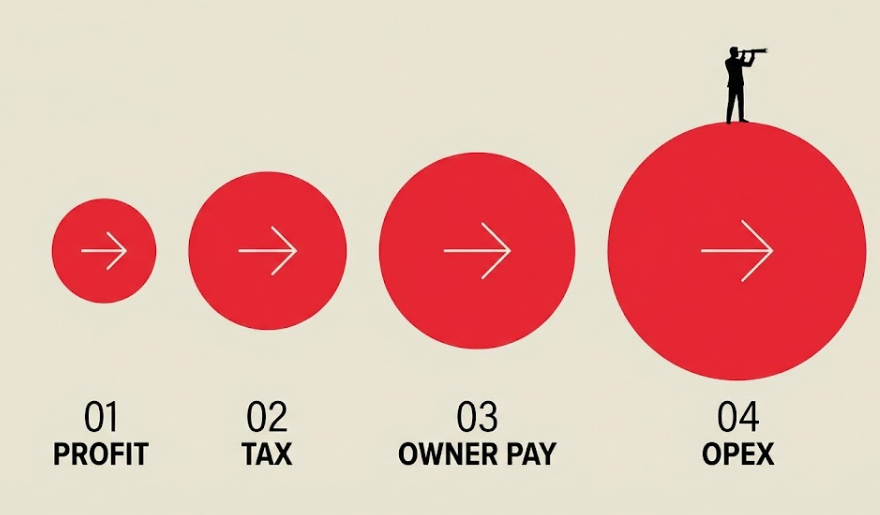
To set up Profit First bank accounts, you must open five distinct checking accounts: Income, Profit, Owner’s Pay, Tax, and Operating Expenses. You deposit all revenue into “Income” and then transfer specific percentages into the other four “buckets” twice per month. This physical separation prevents you from accidentally spending your profit or tax money on daily operations.
To make the Profit First System work, you need “financial friction.” If your profit is in the same account as your payroll, you’ll most likely spend it.
Step 1: Establish The Five Foundation Accounts
Stop treating your bank account like a black hole. Step 1 is the mechanical shift from theoretical profit to operator reality by building your financial infrastructure. Without these five distinct accounts, you are just guessing at your margins.
- Income: All revenue lands here.
- Profit: Your “Confidence Capital” (1% to start).
- Owner’s Pay: Your guaranteed salary.
- Tax: The government’s share.
- Operating Expenses (OpEx): What is left to run the business?
Step 2: The Transfer Schedule
Twice a month (the 10th and 25th), move money from the Income account into the other four based on your percentages.
Here’s a sample script you can use for your bank teller: “I need to open five separate checking accounts. I want them labeled specifically: Income, Profit, Owner Pay, Tax, and OpEx. I do not want overdraft protection between them. Each must be a standalone bucket.”
What Are The Best Banking Platforms For Profit First System Implementation?
The best banking platforms for the Profit First System are Relay Financial, Mercury, and Novo because they offer unlimited sub-accounts without minimum balance fees. Relay is the top choice because it allows for automated percentage-based transfers between your sub-accounts. Traditional big banks often charge fees for small account balances, which makes the 1% profit habit difficult and expensive to maintain.
Traditional big banks are profit-killers. They charge “minimum balance” fees on your Profit account, which defeats the purpose of starting at 1%.
- Relay Financial: The gold standard for agencies. Built specifically for Profit First with automated percentage transfers and 20 free sub-accounts.
- Mercury: Excellent for tech-heavy agencies. Offers multiple accounts and a great UI, though it has less automation for specific Profit First logic.
- Novo: A solid mobile-first option that allows for “Reserves,” though it functions slightly differently than standalone checking accounts.
How To Handle Inconsistent Agency Income With The Profit First System?
To handle inconsistent agency income, you must decouple your monthly distributions from your monthly deposits by using a “Drip Account” to stabilize cash flow. This secondary holding account captures revenue from high-performance months and releases it in steady, predictable increments during slower periods. By feeding your main Income account a fixed amount every two weeks, you ensure your operating cadence remains stable even when client payments are lumpy.
The “Drip Account” Operator Move
For agencies in the $1M–$5M (Operator Scale) stage, a single Income account is often not enough to manage volatility.
- The 6th Account: Open a “Drip Account” where all client payments land first.
- The Release Valve: Transfer exactly 1/6th of the Drip Account balance to your main Income account on the 10th and 25th of every month.
- The Buffer: This prevents the “feast or famine” trap where a $150k month leads to overspending, leaving you insolvent during a $40k month.
How To Tell If Your Agency Is Overstaffed Using Profit First Metrics?
You can tell if your agency is overstaffed by calculating your “Real Revenue” (Gross Income minus pass-through contractor costs) and comparing it to your OpEx allocation. If your payroll costs consistently force you to “borrow” from your Tax or Profit accounts to make ends meet, your internal team is too large for your current margins. Using these hard percentage gates provides a “Yes/No” decision tree for hiring and firing based on actual fiscal health rather than “growth” feelings.
The Real Revenue Audit
Payroll is the largest expense in any agency, and hiring “ahead of growth” is the fastest way to kill your pricing power.
- Calculate Real Revenue: Take your total revenue and subtract every dollar paid to external freelancers, ad spend, and white-label partners.
- The 50% Rule: For a healthy agency, your total internal payroll (including your own salary) should never exceed 50% of your Real Revenue.
- The Efficiency Metric: Measure your Profit-per-employee. If this number is trending down while your revenue is trending up, you are adding “complexity weight” that will eventually stall the business.
The Overstaffing “Red Flags” Checklist:
- Borrowing: You have to skip a Profit transfer to cover the team’s health insurance.
- Margin Erosion: Your NRR (Net Revenue Retention) is high, but your Profit account is stagnant.
The Key Man Trap: You have 20 employees, but you are still the only person who can close a deal or solve a technical crisis.
The hard truth is that scaling your revenue won’t fix a broken operating cadence. If you cannot find a profit at $10k a month, you won’t magically find it at $100k. Establish your five Profit First foundation accounts now and treat profit as a non-negotiable expense. Stop letting your agency eat your paycheck and start building a predictable, exit-ready asset.
FAQs
How do I handle debt with profit first? You must treat debt repayment as a non-negotiable line item within your existing OpEx percentage. This ensures you pay down liabilities with real margin instead of using new client deposits to mask old mistakes.
How often should I transfer money between accounts? The standard cadence is the 10th and 25th of every month. This aligns with typical payroll cycles and provides a clear bi-monthly snapshot of your agency’s health.
How to stop revenue disappearing when contractor costs are high? You must calculate your Real Revenue by subtracting all pass-through contractor costs before making your distributions. Focusing on the margin left after external delivery is the only way to see your true spending power.
How do I know if my agency can afford a new hire? A hire is affordable only if your Owner Pay and Profit accounts remain fully funded after the new payroll is added. Your Operating Expenses account must act as the hard ceiling for all headcount decisions.
When should I increase my profit percentages? Increase your target percentages by 1% every quarter until you reach your stage-specific goal. This gradual approach allows operations to adjust to leaner spending without triggering a cash flow crisis.