


You added the AI tools to move faster. Instead, you’re spending part of every day toggling between them, double-checking outputs that sound confident but might be wrong, and wondering which tool’s answer to actually trust. What you’re describing is AI tool overload, not an AI problem.
That’s not a you problem. A Boston Consulting Group study, published through Harvard Business Review, surveyed around 1,500 workers and found that about one in seven report real mental fatigue from juggling AI tools. Researchers are calling it “AI brain fry.” The pattern gets worse with tool count: people using three or more AI tools at once show meaningfully worse fatigue and error rates than people using one or two.
Why Are More AI Tools Making Your Decisions Worse, Not Faster?
Here’s the number that should stop you. A 2025 MIT Media Lab report tracking $30 to $40 billion in enterprise AI spending found that the vast majority of AI initiatives fail to deliver a measurable return. The overwhelming majority of enterprise AI pilots show no measurable business return, and the problem is tool sprawl, not AI.
Here’s the inside-circle term worth knowing: tool sprawl. In plain English: this means you’ve added more AI tools than anyone can account for, so nobody knows which one to trust for which decision, and the supervision cost quietly eats the time savings.
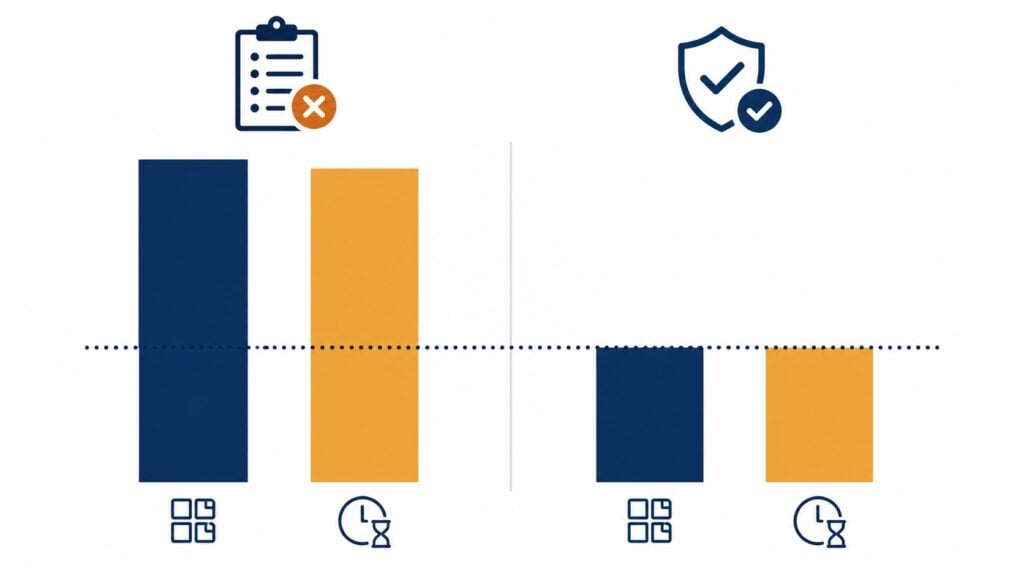
The BCG research backs this up directly. Tasks that require heavy oversight of AI output demand more mental effort and produce a real jump in fatigue, compared to lighter AI use. Workers who hit that fatigue threshold make significantly more major mistakes than colleagues who don’t, and report wanting to quit more often. You didn’t add AI tools to build a second job watching AI tools. But without a system, that’s what tool sprawl becomes.
Why Does AI Tool Overload Cost More at Each Revenue Stage?
$100K–$1M: This is where sprawl starts. You’re moving fast, trying new tools weekly, and nobody’s tracking which ones actually earned their place. The team is small enough that confusion about “which tool do I trust” still gets solved by just asking you directly, which quietly makes you the bottleneck again.
$1M–$5M: This is where it compounds. You’ve got more people, more functions, and more tools per function. Nobody has the full picture anymore. A marketing hire trusts one AI tool’s output, a finance hire trusts a different one for the same type of question, and the two disagree with nobody positioned to say which is right. Tool sprawl doesn’t just waste subscription budget. It compounds into decisions made with false confidence.
$5M–$10M: The cost shows up as compounding bad decisions made with false confidence, not just wasted subscription spend. At this size, a wrong call made two layers below you, backed by a confident-sounding AI answer nobody verified, can cost real money before it surfaces. If this exhaustion is bigger than your tool stack and starts touching how you feel about the role itself, that’s a different, more foundational question. We covered that one directly in when should a founder step down.
Should You Add Another AI Tool, or Audit the Ones You Have?
The instinct when a tool feels like it’s not delivering is to add a better one. That’s the trap. Research on tool count shows the fatigue and error problems get worse, not better, past a certain number of tools in active use. Adding a 6th tool to fix what tool #4 and #5 aren’t doing well just deepens the sprawl.
The wedge: run a quarterly audit instead of a constant tool search. You’re not looking for the perfect stack. You’re looking for the smallest stack that still gets the decision made correctly, with someone clearly accountable for trusting it.
How Do You Run a Quarterly AI Tool Audit in Four Steps?
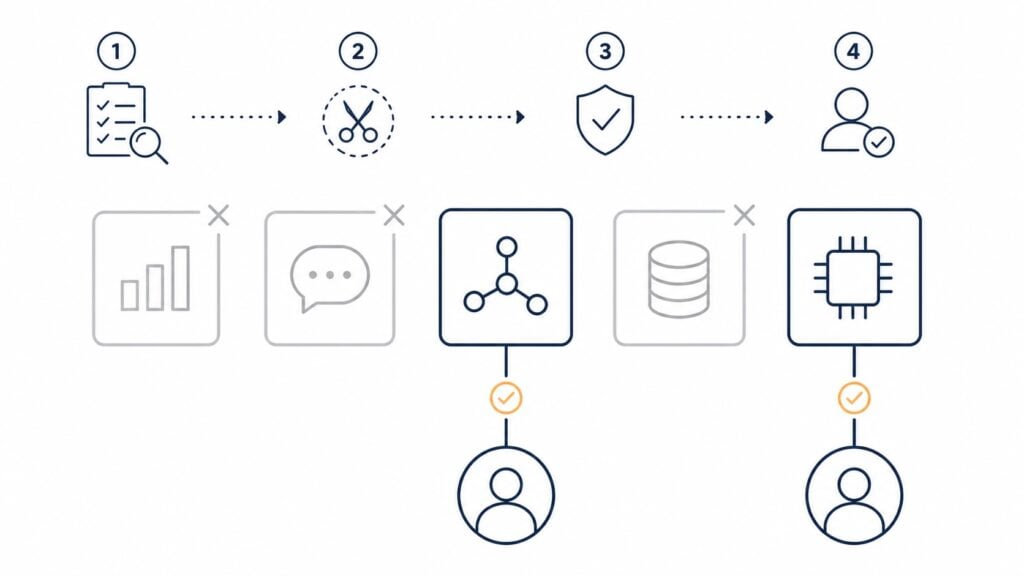
Step 1: Run the Tool Audit
List every AI tool in active use across your team. Not just the ones you approved. Founders routinely discover three to four times more AI tools in active use than they thought, once someone actually counts, because employees quietly adopt tools nobody signed off on.
For each tool, capture three things: who uses it, what decision it touches, and whether anyone could explain in one sentence why it’s still around. The same documentation discipline that protects you in a cap table negotiation applies here. If it’s not written down, it’s not real.
Step 2: Assign a Decision-Rights DRI
For each function (sales, finance, ops, marketing), name one person as the Directly Responsible Individual for deciding which AI tool’s output gets trusted on which call. This isn’t about picking favorites. It’s about making sure that when two tools disagree, someone has the authority to make the call instead of everyone defaulting to whichever answer sounds most confident.
This is the same key-man risk we’ve covered before in the context of when to hire a COO: if only you know which tool to trust, you’ve quietly recreated the exact bottleneck a real operational hire is supposed to solve.
Step 3: Require a Verification Step
Before any AI output drives a real business decision, especially the hard-to-reverse kind, it needs a documented check. This doesn’t need to be heavy. It can be as simple as a second person confirming the number, the quote, or the recommendation against a source before it’s acted on.
Step 4: Review ROI Quarterly
Every 90 days, look at each tool against a simple bar: is it still earning its place? Cost against measurable time or decision-quality gain. Cut anything that’s coasting on habit rather than results.
Common Mistakes and What They Cost
- Tool-hopping instead of auditing. Chasing every new AI release maximizes tool count, not decision quality, and resets your team’s learning curve every time.
- Trusting confident output without a check. Higher confidence in an AI answer tends to come with less scrutiny applied to it, which is exactly the moment mistakes slip through.
- No named owner. Without a DRI, disagreements between tools get resolved by whoever sounds most sure, not whoever is most accurate.
Would I Fire Someone for These AI Tool Mistakes?
- Adopting a new AI tool without telling anyone what decision it’s for? Yes gate. That’s how sprawl starts.
- Acting on an AI-generated number or recommendation on a high-stakes call without a verification step? Yes gate.
- Asking “which tool should I trust for this?” and getting a shrug instead of a name? That’s not the employee’s failure. That’s a missing DRI, and it’s on you to fix.
- Running the quarterly tool ROI review even when it’s inconvenient? No gate. Skipping it is the actual problem.
Real Numbers: What Sprawl Costs vs. What an Audit Costs
Note: precise dollar figures on “cost per AI-driven mistake” don’t exist in a single clean study. The ranges below are illustrative, built from typical time costs at this stage, not a hard citation, and flagged as such rather than presented as verified fact.
| Unaudited stack (5-person team) | After quarterly audit | |
| Avg. AI tools per employee | 4–6, undocumented | 2–3, documented with an owner |
| Time spent daily reconciling conflicting AI outputs | ~30–45 min/employee (illustrative) | ~10 min/employee (illustrative) |
| Weekly hours lost to supervision overhead, team-wide | ~3–4 hours (illustrative) | ~1 hour (illustrative) |
| Decision verification step in place | Rare, ad hoc | Required before high-stakes calls |
| What breaks this math | If your team is under 3 people, sprawl costs less in hours but still costs in wrong calls made with false confidence |
What to Do Next
In the next 24 hours: List every AI tool your team is actively using. You will likely find more than you expect.
In the next 7 days: Assign a decision-rights DRI for at least your two highest-stakes functions (commonly finance and whichever function touches customers directly).
In the next 30 days: Run your first quarterly ROI review. Cut anything that can’t justify its place with a specific decision it improves.
Frequently Asked Questions
Isn’t this just an argument for using less AI?
No. The research actually shows AI reduces burnout when it offloads repetitive tasks. The problem is specifically the oversight burden of too many overlapping tools, not AI use itself.
What if my team resists a formal audit?
Frame it as protecting their time, not adding process. The point is fewer tools to manage, not more paperwork.
How is this different from just picking one AI vendor for everything?
A single vendor doesn’t solve the underlying issue if nobody’s accountable for verifying its output on high-stakes calls. The DRI and verification step matter more than vendor count.
What does a Decision-Rights DRI actually do?
A DRI is the named person accountable for deciding which AI tool’s output gets trusted for a specific decision, so disagreements are resolved by authority, not by whichever answer sounds most confident.