


QUICK SUMMARY: Wanting to grow but unsure if you have the resources to expand? Here’s how to scale without hiring at $1M to $10M ARR. Run a role relevance audit, verify bottlenecks with data before opening a req, test automation or contractors first, and check whether the real problem is decision rights instead of headcount. Capital efficiency is a math problem. This playbook shows the numbers.
Series B founders are being told to cut burn and prove capital efficiency, and the first instinct is almost always a hiring freeze. That’s the wrong starting move. A freeze without a system behind it just moves the exhaustion from a job posting to a team that’s already stretched thin, and six months later you’re hiring anyway, just later and at a higher price. Generic “do more with less” advice never tells you which roles to skip, which to automate, and which to still fill. Here’s how to scale without hiring: a role-by-role framework built around the same ARR-per-employee and burn-multiple numbers investors are already using to judge your growth-stage company.
What Does Capital Efficiency Actually Mean at $1M to $10M ARR?
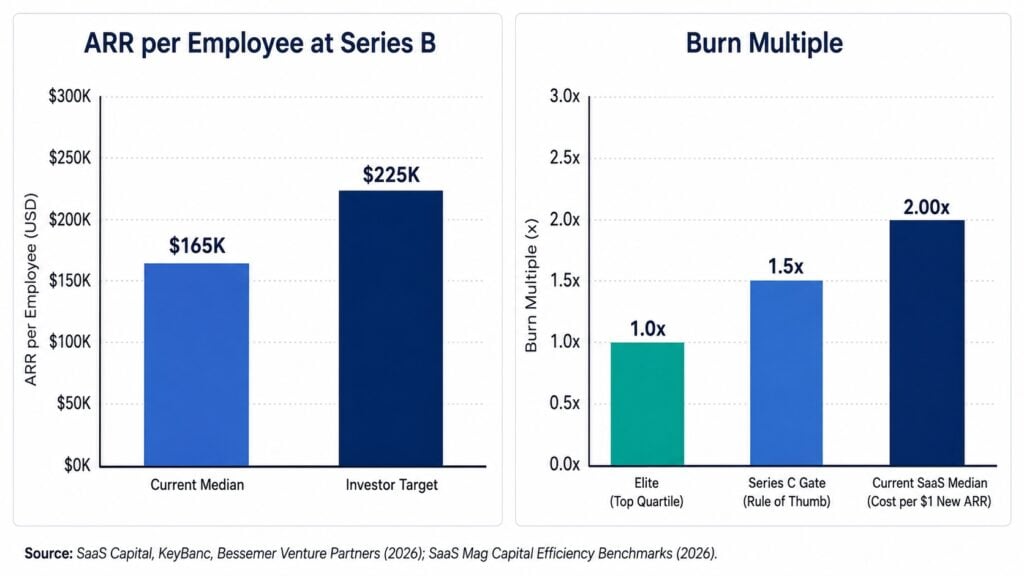
Capital efficiency has a real definition at Series B: investors currently expect roughly $165,000 in ARR per employee, and they’re pushing the target toward $225,000, according to 2026 benchmark data compiled by Stealth Agents from SaaS Capital, KeyBanc, and Bessemer Venture Partners. Below Series B, the number matters less than the direction. If your ARR per employee is flat or falling while headcount grows, you’re buying growth with dilution.
Why Does Hiring Feel Like the Only Fix?
Two things usually drive the urge to hire, and neither one is actually a headcount problem. The first is a process that only lives in one person’s head, so every new task feels like it needs a new pair of hands. The second is a missing decision maker. Matt Mochary’s RAPID framework calls this a missing DRI, a Directly Responsible Individual for the function creating the pressure. Our decision-making frameworks piece walks through how to assign one before you open a req.
How to Scale Without Hiring: The 5-Step Play
Run these five checks in order before you post a job.
- Audit role relevance. Map every current and planned hire to one measurable KPI it moves.
- Verify the bottleneck with data. Pull time-tracking and ticket-volume numbers before you trust a feeling from a Monday meeting.
- Test automation or a contractor first. Stefan Georgi’s copy-thinking framework applies directly here: direct the work before you assume it needs a full-time employee.
- Barbell the uncertain work. Keep your core team lean and permanent. Staff anything you’re not sure you’ll need in six months with contractors, per Nassim Taleb’s barbell strategy.
- Have the capacity conversation before you decide. Ask your team what would make the workload impossible. Our team-scaling framework covers how to do this without losing culture as you grow.
When Is Hiring Still the Right Call?

Sometimes the answer really is hire. A role that directly closes revenue, like sales or a critical technical hire blocking a shipped feature, usually pays for itself faster than any workaround. Our COO-hiring bottleneck test walks through the specific signals that separate a real hire from a system you haven’t built yet.
What Does This Actually Cost?
Here’s the math. A fully loaded hire typically runs 1.25x to 1.4x base salary once payroll taxes, benefits, and overhead are counted, a formula popularized by MIT senior lecturer Joseph Hadzima. A $140,000 salary role usually lands closer to $175,000 to $196,000 in true annual cost. The median SaaS company now spends $2.00 to generate $1.00 of new ARR, up 14% since 2023, according to SaaS Capital Efficiency benchmarks published by SaaS Mag. A 1.0x burn multiple is elite. Up to 1.5x is the floor for Series C readiness, per Foundry CRO’s 2026 benchmarks. That math flips if the role you’re avoiding actually closes revenue.
The costliest mistake is skipping the documentation that lets the current team absorb more work. Codie Sanchez calls the underlying failure key man risk. The business breaks the moment one person is out, hired or not. A second expensive mistake is delaying a genuinely revenue-generating role because it got lumped into a general freeze.
Would You Fire Someone for This Decision?
Run the open role through these four gates before you post it.
- Have you confirmed the bottleneck with data, not just a feeling?
- Have you tested automation or a contractor for 30 days first?
- Is there a name attached to this decision, a DRI, or is it drifting?
- Does this role move a number you can point to in six months?
If you can’t answer yes to all four, the role isn’t ready for posting yet.
Frequently Asked Questions
What’s a good ARR per employee for a growth-stage company?
Series B investors are currently looking for roughly $165,000 per employee, pushing toward $225,000, per 2026 SaaS benchmark data.
Should I ever hire during a capital efficiency push?
Yes, when the role directly closes revenue. Delaying a real revenue hire usually costs more than the payroll it saves.
What’s the fastest way to test if I actually need to hire?
Pull 30 days of time-tracking or ticket data first. If the bottleneck doesn’t show up in the data, it’s not a hiring problem yet.
What’s a fully loaded cost for a new hire?
Budget 1.25x to 1.4x base salary once payroll taxes, benefits, and overhead are included.
What’s the biggest hiring mistake at this stage?
Delaying a role that directly closes revenue because it got swept into a general freeze.