


You keep seeing the same headline. Mergers and acquisitions (M&A) are surging. Buyers are active. This might be your window.
But here’s the problem: You have no real idea what your business is worth to a buyer. And you’re not sure the one thing buyers actually check is whether the business needs you personally to survive. Every broker guide tells you to watch the market. That’s backwards. The market doesn’t set your price. Your owner-dependency does.
This piece gives you a 10-minute test to find out if you’re sale-ready right now, and what a realistic number looks like if you’re not.
What actually changed in the M&A market this year?
The surge is real. Global deal kickoffs, the earliest signal of deals in motion, rose 31% in the first half of 2026 compared to the same period last year, according to Datasite Insights. In plain English: more buyers are quietly lining up deals before anything goes public.
Mid-market M&A, the band most owner-operated businesses fall into, climbed 5% in volume and nearly 14% in value over the same stretch, according to mid-market deal coverage from The Middle Market. Advisors point to private equity firms under pressure to finally exit aging portfolio companies as one driver.
None of that changes what your business is worth. It only changes how many buyers are looking.
Why does this matter differently depending on your stage?

Owner-dependency doesn’t look the same at $200K in revenue as it does at $8M, but the earlier you catch it, the cheaper it is to fix. Here’s how the risk (and the payoff) shifts as the business grows:
- At $0 to $100K, this isn’t about selling yet. It’s about building the habit now so you’re not starting from zero later.
- At $100K to $1M, most owner-dependency risk lives right here. You’re the pricing decision, the vendor relationship, and the onboarding process, often all three at once.
- At $1M to $5M, your multiple is directly gated by whether those systems are written down anywhere. This is the range where the real money gets made or lost at sale.
- At $5M to $10M, private equity and strategic buyers are actively looking right now, per the data above. Readiness work pays off fastest here because the buyers are already circling.
What if selling isn’t actually the right question?
Try reframing it. You’re not deciding whether to sell your business. You’re deciding whether to stop being its single point of failure.
That work matters whether or not you ever sell. A business that survives two weeks without you is also a business that’s less stressful to run on a random Tuesday. The M&A surge is just the excuse to finally do work you should be doing anyway.
What’s the 4-step test that tells you if you’re sale-ready?
Run the two-week absence test first. Not a partial vacation where you still check email. A real absence, tracked closely for what breaks.
Then build an owner-dependency inventory. List every customer relationship, vendor term, pricing decision, and piece of tribal knowledge that currently lives only in your head.
Check yourself against what buyers actually look for. According to CT Acquisitions’ sub-$5M exit playbook, buyers focus on three things: who really runs the business, whether revenue survives the owner’s exit, and whether systems, pricing, and relationships are documented anywhere.
Only after that should you decide sell versus scale. Both paths require the same fix.
What business mistakes cost you the most money?
Listing before you document your systems is the most expensive mistake on this list. Prepared sellers who fix these issues six to twelve months before listing see a 15 to 30 percent lift in net proceeds compared to owners who list as-is, according to the CT Acquisitions data above.
Anchoring your asking price to “the market is hot” instead of your own SDE or EBITDA multiple comes second. Buyers don’t pay for headlines. They pay for your specific numbers.
Showing eagerness to a buyer is the third mistake worth naming. Negotiation research consistently finds that visible urgency reads as weakness and gets priced accordingly. A buyer who senses you need this deal will offer less for it.
Would your business pass the standard you’re holding your employees to?
Run your own business through this filter.
Would you fire an employee who couldn’t explain how your pricing decisions get made? If the honest answer is yes, that standard applies to you too, and right now you probably can’t explain it to a buyer either.
Would you fire someone who kept every vendor relationship in their head with nothing written down? That’s likely you, today.
Would you fire someone for never documenting the customer onboarding process? Same standard. Founders don’t get an exception.
The Real Numbers Box
Assumptions: A $2M revenue service business with $400K in seller’s discretionary earnings (SDE), currently unprepared, meaning undocumented systems and heavy owner-dependency.
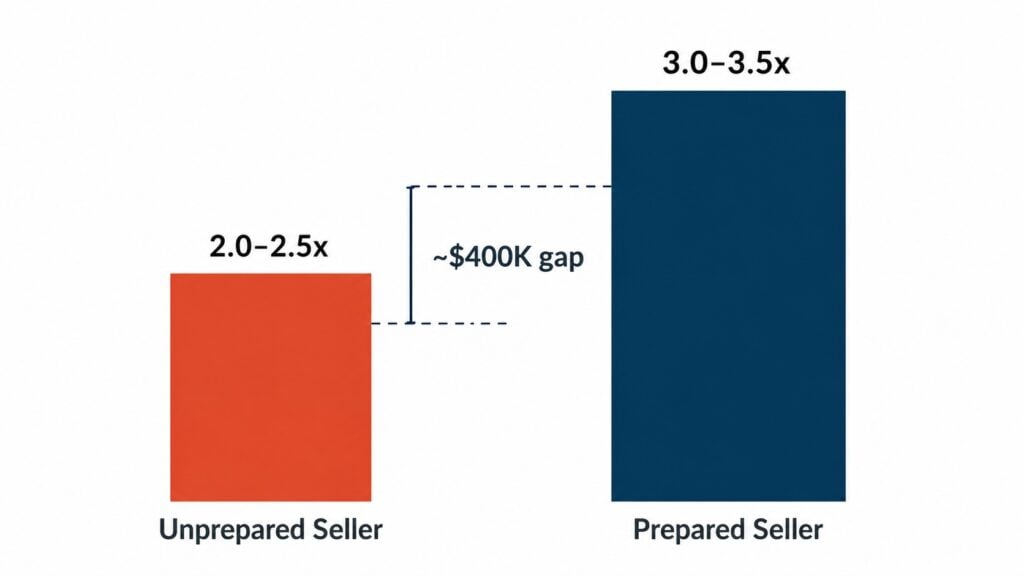
The math: A prepared seller in this position typically commands 3.0 to 3.5 times SDE, or $1.2M to $1.4M. An unprepared seller gets discounted to 2.0 to 2.5 times SDE, or $800K to $1M, because buyers price in the key-man risk.
That gap, roughly $400K, is the price of skipping six to twelve months of documentation work.
What breaks this math entirely: customer concentration above 20% with a single client, revenue that collapses within 90 days of the owner stepping away, or an asking price anchored to “the market is hot” with no buyer-side verification behind it.
Selling Your Business: What to do in the next 24 hours, 7 days, and 30 days
You don’t need a plan yet. You need three concrete actions, scaled to how much time you have:
- In the next 24 hours, block two weeks on your calendar, 90 days out. A real absence test, not a working vacation.
- In the next 7 days, write down every decision that currently only you can make. That list is your documentation backlog.
- In the next 30 days, have one real conversation with a broker or M&A advisor. Not to list your business. Just to hear what they’d flag in diligence today.
If you want a deeper look at how ownership and equity decisions compound over time, our guide to cap table management and founder dilution covers the same owner-dependency principle from the funding side rather than the exit side.
Frequently Asked Questions
Is now a good time to sell a business?
Market conditions matter less than most owners think. Deal activity is up in 2026, which helps buyer appetite, but your price is set by your own owner-dependency and financials, not the headline.
How do I know if my business is ready to sell?
Run the two-week absence test. If the business runs without a single owner decision for two weeks, you’re ready. If not, that’s the fix to make before you list.
What hurts a business’s sale price the most?
Owner-dependency. Buyers discount heavily for businesses where revenue, pricing, or key relationships live only in the founder’s head.
Should I sell now or keep scaling?
Both paths require the same work: a business that runs without you. Decide the sell-versus-scale question only after that’s true.