


QUICK SUMMARY: Decision-making frameworks for founders reduce to one question: reversible or not? Decide reversible calls, undoable in 30 days at under 10% of burn, in 2 hours using the 70% confidence rule. Irreversible calls, like equity or senior hires, need a 48-hour minimum and one named owner. Review outcomes monthly to calibrate judgment.
Decision-making frameworks for founders solve one problem: not speed, but classification. You’re making 20 to 40 calls a day with incomplete information, no playbook, and real money on the line, and founders who decide well aren’t faster thinkers. They’ve learned to classify each decision before they act, and that classification, not raw speed, is what actually determines how fast they should move.
A wrong hire, a mistimed pivot, or a bad partnership costs you months at this stage, sometimes everything, because none of it is recoverable the way it is for a big company. This kind of grinding uncertainty is also a leading driver of founder burnout, which is exactly why getting the classification right matters beyond just the individual decision.
The advice you’ve been given is almost entirely useless at this stage. “Move fast and break things” is a $50 billion company’s luxury. “Trust your gut” is what founders say after they survived, not what got them there. And the MBA frameworks assume data you don’t have, committees you can’t afford, and timelines that don’t exist in a real startup.
Is This Decision Reversible in 30 Days at 10% of Burn?
The standard story is that founders freeze because they’re afraid of being wrong. That’s true, but it’s incomplete. The deeper problem is that most founders apply the same deliberation process to every decision regardless of type. A pricing test and a co-founder equity split get the same anxious three-week treatment. That’s not caution. That’s misclassification costing you momentum.
How Do Successful Founders Make Fast Decisions?
They don’t decide fast on everything. They decide fast on reversible decisions and slow on irreversible ones. The speed comes from rapid classification, not rapid thinking. Founders who move well have pre-built criteria for recurring situations. They’ve done the thinking before the moment arrives, so the decision itself takes 10 minutes instead of 10 days.
Reversible means you can undo it in under 30 days at under 10% of your monthly burn. Everything else is irreversible. Reversible examples: a pricing test, a contractor hire, an ad spend change, a product feature flag. Irreversible examples: co-founder equity, enterprise contract terms, a full-time senior hire, geographic expansion.
Two things that change the game when you internalize this. First: the 70% confidence rule. Decide when you’re 70% confident, not 95%. Getting from 70% to 95% confidence takes four times longer and moves the outcome by less than 5%. Second: the cost of not deciding. A stalled team, a competitor who moved while you deliberated, and runway burning on an undecided initiative. These costs rarely show up in the deliberation math. They should.
Why Do 65% of Startups Fail Over Co-Founder Conflict?

Founders misclassify in both directions. They treat irreversible decisions as reversible (“we can always fix it later”), and they treat reversible decisions as irreversible (“what if we’re wrong?”). Both errors are expensive: treating a reversible call as if it were permanent kills momentum, while treating a permanent call as if it were reversible can kill the company.
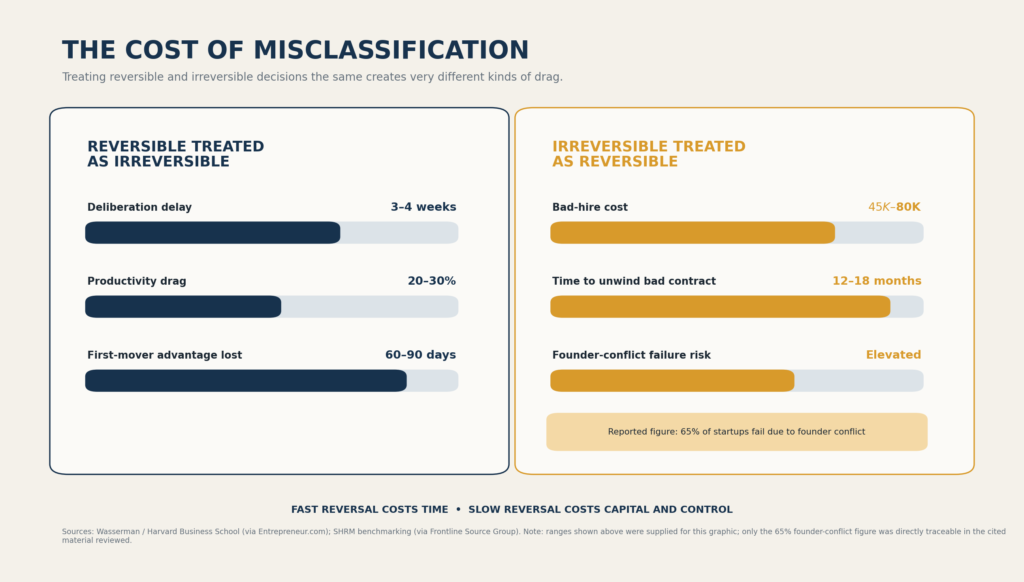
Here’s what that actually costs, broken down by which mistake you’re making.
Real Numbers: The Cost of Misclassification
Reversible decision treated as irreversible: Average founder deliberation time on a 2-hour decision runs 3 to 4 weeks. Team productivity drag on undecided initiatives runs 20 to 30%. First-mover advantage on competitive moves averages 60 to 90 days. You’re giving that away for free.
Irreversible decision treated as reversible: founder conflict and not product failure, is the reason 65% of high-potential startups fail, according to Harvard Business School research on founder dynamics, and equity disputes are one of the most common triggers. The average cost to undo a bad senior hire uses SHRM’s full-replacement benchmark of 50% to 200% of annual salary, and CareerBuilder reports average mis-hire losses climbing to $240,000 or more at the executive level. Enterprise contract missteps take 12 to 18 months to unwind from terms that took 2 hours to sign.
What fixes it: move fast on cheap, testable decisions. Apply a hard 48-hour minimum on expensive, hard-to-undo ones.
The classic misclassification founders universally regret: “We can always change the culture later.” You can’t. By the time it’s a problem, it’s already baked in three layers deep. The other one: believing urgency is real when someone says “we need an answer today” on a major commitment. Urgency on an irreversible decision is almost always a manipulation tactic or a cognitive bias amplifier. Slow down when it shows up.
What Changes in Your Decision Process at 15 People?
Stage matters. A system built for a solo founder breaks down once you hit 15 people, and a system built for 15 people is overkill at 3.
- Pre-Seed / Solo (0 to 3 people, $0 revenue): You are the DRI. Every decision touches you. That’s not fixable yet and it doesn’t need to be. Build one habit now: for every decision, ask “reversible or not?” before you ask anything else. Time budget for reversible decisions is 2 hours maximum. Set a timer and decide. Time budget for irreversible ones is 48 hours minimum after your first instinct. Sleep on it, literally. If you can’t write down the decision criteria in 10 minutes, you’re not ready. Gather one more data point, then write it, then decide.
- Early Stage (4 to 15 people, $0 to $2M revenue): The biggest failure mode here is a CEO who still owns all decisions on a 10-person team. You’re making 1-person decisions at 10-person scale. The fix is DRI assignment. For every recurring decision category (hiring, pricing, product priority, partnerships), name one owner, ideally not you. This is the same bottleneck test that determines when it’s time to hire a COO: if you’re still the default owner of every decision type on a team this size, the fix might not be a scorecard. It might be your next hire. Then build your first decision scorecards. A hiring scorecard has 5 to 7 criteria, pre-weighted. Any candidate who doesn’t hit 4 of 7 is an automatic no, with no further deliberation needed.
- Growth Stage (16 to 50 people, $2M to $10M revenue): The bottleneck shifts from personal to organizational. Install written pre-reads: any decision requiring more than 30 minutes of meeting time needs a one-page brief circulated 24 hours in advance. Run a weekly decision review: what got stuck, who lacked clear authority, and whether the fix is in the architecture rather than the people.
Track your decision log the same way you’d audit any other tool creeping into your stack: if it’s not actually reducing decision time, cut it. Most founders try to keep this in their head, which is exactly why nothing gets calibrated. A structured decision journal gives you a place to log the call, the reversibility class, and the outcome, so the monthly review below has something real to look back on.
Monthly review of major decisions versus outcomes is the highest-leverage data you can build at this stage. It calibrates your judgment faster than anything else.
How Do You Apply the 70% Confidence Rule?
This is where decision-making frameworks for founders actually pay off: four that work at $0-$10M, not MBA theory, tested stage by stage.
What Frameworks Reduce Decision-Making Time for CEOs?
- The Reversibility Matrix: Two axes: reversibility (easy vs. hard) and cost (low vs. high). Easy plus low means decide in 2 hours. Hard plus high means 48-hour minimum. This is the whole classification system in one quadrant. Build it on a whiteboard once and you’ll use it weekly.
- The 70% Rule: Decide when you’re 70% confident, not 95%. The jump from 70% to 95% costs 4 times the time and moves outcomes by less than 5%. “Good enough to test” beats “perfect before launch” on anything reversible.
- The Decision Scorecard: Pre-built criteria for your most frequent decision types: hiring, vendor selection, partnerships, pricing. Five to ten weighted items. Any option that clears the threshold is a yes, and anything that doesn’t is a no, with no separate deliberation round. The first version is rough. After ten uses it’s calibrated to your actual standards.
- DRI Assignment: One person owns each decision, not a committee, and that person is responsible for the outcome, not just the choice. Takes 5 minutes to assign. Saves days per decision once your team hits 6 or more people.
Who Should Own Your Next Hiring or Pricing Decision?
Speed and quality only conflict when classification is wrong. The fastest decisions with the best outcomes share three features: pre-built criteria, clear single ownership, and correct reversibility classification. Get those three and the decision itself is almost mechanical.
When a decision is stalling, here is the script:
When a decision is stalling, here are three questions you can use. Ask them in this exact order, out loud if you have to:
- “Is this reversible in under 30 days at under 10% of our monthly burn?” If yes, decide in 2 hours: set a timer and decide.
- “Do we have 70% of the information we need?” If yes, decide now. If no, identify one specific data point that would get you there, gather it, then decide.
- “Who owns this decision?” If the answer is unclear, name the DRI right now and let them decide immediately. Do not schedule a meeting to discuss who should decide.
If you’ve asked all three and still can’t decide, that’s usually a signal the underlying strategy isn’t set yet, not a sign you need a better decision process. That’s worth its own meeting.
Common Mistakes: Deciding by committee on things that need one owner. Waiting for 95% confidence on things that only need 70%. Treating a 3-day reversible test like a permanent commitment. Not tracking outcomes, so every similar decision starts from zero and you never get calibrated.
Your 24h / 7d / 30d Action Sequence
- In the next 24 hours: Audit your open decisions right now. Write down every decision that’s been waiting more than 3 days. For each one, ask the reversibility question. You will find at least 3 that are reversible and you’ve been treating as hard. Decide those today. Set a 2-hour timer per one and go.
- In the next 7 days: Pick your highest-friction recurring decision category, usually hiring or resource allocation. Build a 5-item scorecard for it. Write the criteria before the next decision arrives, not during it. Name a DRI for every open project that currently has committee ownership.
- In the next 30 days: Run your first decision log review. What did you decide this month? Reversible or not? Right speed applied? Identify the one decision type where you consistently move too slow and build a dedicated scorecard for it. If you’re 10 or more people, hold one 30-minute decision architecture session. Map every recurring decision category to a DRI and post it where the team can see it.
The framework won’t be perfect on day one; it gets calibrated by use. The real goal is a system that produces better decisions faster than your current default and keeps improving because you’re actually tracking outcomes, not a scoreboard of perfect calls. The same tracking discipline that calibrates your day-to-day calls is also the earliest, most honest signal for a much bigger decision 🔗-new: whether you’re still the right person to be making them.
Every week, CEO Journal breaks down the systems that actually work for founders at $0-$10M. No theory. Subscribe free below.
This article may contain affiliate links. CEO Journal may earn a commission if you purchase through one of these links. This never influences our editorial coverage.
Frequently Asked Questions
What’s the difference between a reversible and an irreversible decision?
A decision is reversible if you can undo it in under 30 days at under 10% of your monthly burn. Pricing tests, contractor hires, and ad spend changes are reversible. Co-founder equity, senior full-time hires, and enterprise contract terms are not.
How fast should a founder decide on a reversible decision?
Two hours, using a hard timer. If it’s genuinely reversible and cheap to undo, there’s no benefit to deliberating longer.
What is the 70% confidence rule?
Decide once you’re 70% confident instead of waiting for 95%. Closing that last 25% typically takes four times longer and changes the outcome by less than 5%.
What does DRI mean in a decision-making framework?
DRI stands for Directly Responsible Individual: one named person who owns a specific decision and is accountable for the outcome, not a committee.
How often should founders review past decisions?
Monthly, using a decision log that tracks what was decided, its reversibility class, and the actual outcome. That’s what calibrates judgment over time.
Is founder decision fatigue different from ordinary decision fatigue?
Yes. Founders face irreversible, high-stakes calls (equity, senior hires) alongside dozens of reversible daily ones, so misclassifying between the two carries outsized cost compared to routine workplace decision fatigue.