
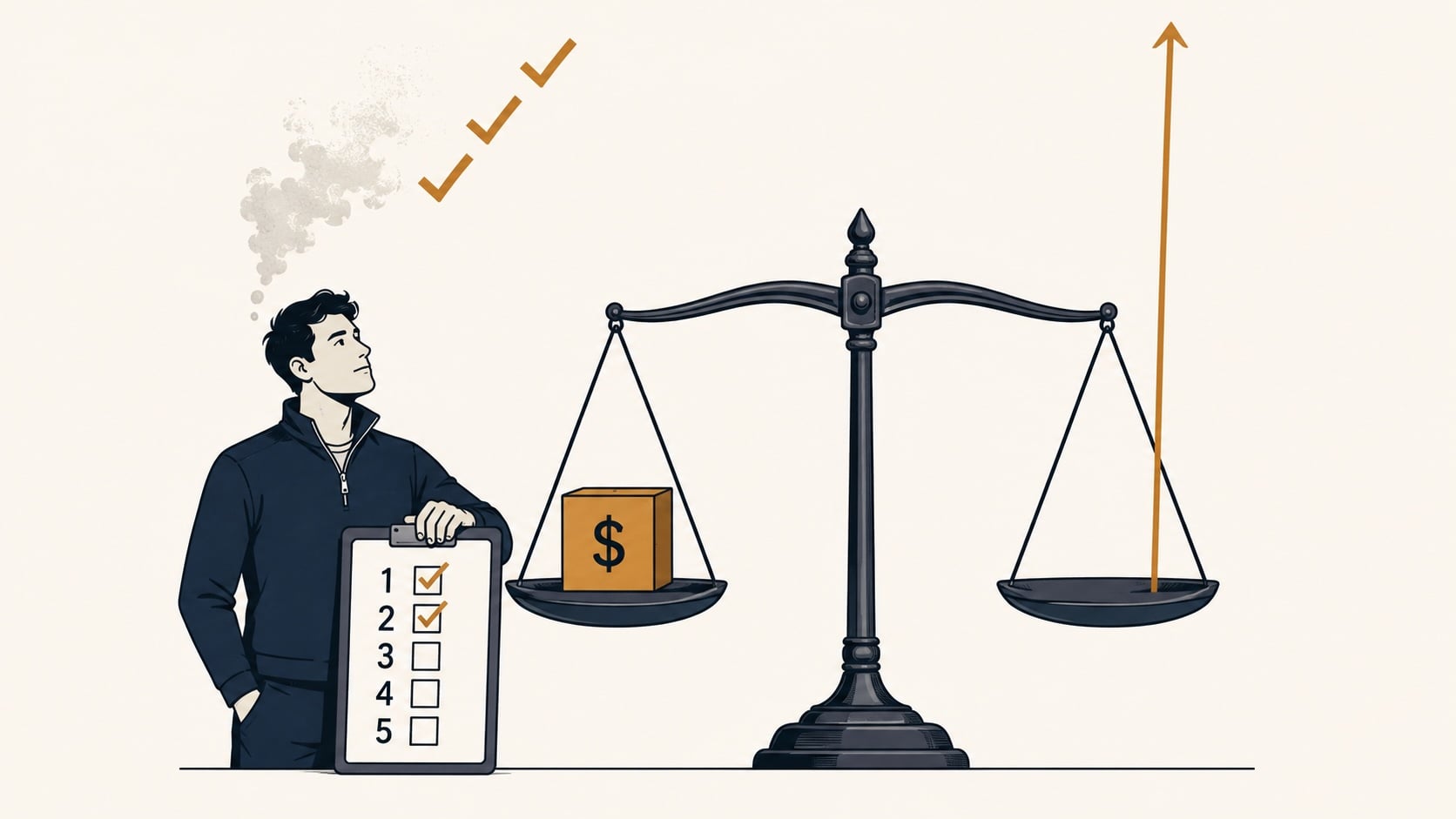

QUICK SUMMARY: Founders can’t tell real warning signs from ordinary fear because both feel identical in the moment. The Founder Fear of Failure Signal Test is a five-step check (name the fear, find the unverified assumption, quantify the real worst case, check the asymmetry, write the decision down) that separates fact from story before a hire, pivot, or spending call gets made.
Why does fear feel different at $1M than at $100K?
At $1M to $10M, fear of failure doesn’t feel like the fear you had at launch. Back then, failure meant closing something that barely existed yet. Now it means undoing something real: employees, clients, a track record people watched you build. A 2016 study in the Journal of Business Venturing based on interviews with 65 entrepreneurs found that fear of failure isn’t one feeling. It’s a mix of stories, assumptions, and half-checked facts that shifts shape depending on what’s being decided.
That mix isn’t random, either. Founders who’ve written about it describe fear rotating through a specific, recognizable cast: fundraising, hiring the wrong person, scaling too fast or too slow, not having enough to make payroll. It rarely shows up as one general anxiety. It shows up as a specific, nameable worry tied to a specific decision.
That mix also changes as revenue grows:
- $0 to $100K: fear centers on whether the business works at all
- $100K to $1M: fear centers on the first real hire and the first real spend
- $1M to $5M: fear centers on scaling too fast or too slow
- $5M to $10M: fear centers on protecting what’s already built and facing a second, visible failure
How Do You Find the Assumption Hiding Behind Founder Fear?
Treat fear of failure as a data problem, not a mood. Founders working through the fear tend to trace it to one specific unchecked fact, not general anxiety, a pattern consistent with the Cacciotti et al. (2016) findings.
Pushing through fear blindly ignores a real signal if one exists. Freezing indefinitely burns cash and morale while nothing gets decided. Neither approach works, because both skip the step where you check what’s actually true.
What Is the Signal Test Founders Use Before a Hard Call?

Run this before any decision fear is trying to make for you.
- Name the specific fear out loud. Not “I’m stressed.” The actual sentence: “I’m afraid this hire repeats the last one that didn’t work out.”
- List the assumption behind it. What do you believe is true that you haven’t actually confirmed?
- Quantify the real worst case. Put a dollar figure and a timeline on it. Fear that stays abstract stays oversized.
- Check the asymmetry. Is the downside capped and the upside open-ended? If so, the fear shouldn’t cast the deciding vote.
- Write the decision down before acting on it. If it only exists in your head, it hasn’t been decided yet.
Each step takes minutes. Skipping any one of them is what turns ordinary fear into an unreviewed decision.
Step five works better with a dedicated place to put it. A physical decision journal, kept separate from regular notes, makes the writing-down step something you’ll actually do instead of skipping.
(This article contains an affiliate link; CEO Journal may earn a commission.)


What Happens When Founders Skip the Signal Test?
Two mistakes show up most often. Ignoring a checked, real signal means repeating a mistake you already had data on. Stalling a decision for weeks because “it feels scary,” with no fact-check attached, quietly costs real money every week it sits.
Both mistakes come from skipping the same step: checking the assumption before deciding.
How Do You Run the Fire-or-Keep Test on a $150K Decision?
Run these on how the fear got handled, not on the decision itself.
- Someone stalls a $150K call for three weeks purely because it feels scary, with no facts checked. Performance problem? Yes.
- Someone makes a permanent call (a termination, a product cut) on anxiety alone, with no reasoning written down. Would that process get signed off? No.
- Someone asks for one outside gut-check before a hard call. Weakness or good process? Good process.
None of these tests judge the decision itself. They judge whether the fear got checked before the decision got made.
What Does the Math Actually Look Like on a $150K Decision?
Take a founder at $2M in revenue weighing a $150K hire, gun-shy after a previous hire at that level didn’t work out. A 90-day delay costs lost output and lets a competitor move first. Repeating the bad hire costs severance, a new search, and months of lost ramp time again. Exception: with under three months of runway, delay may be the right call regardless. The Signal Test still applies. The asymmetry math just points somewhere else.
Waiting doesn’t make the cost disappear. It just moves the cost from one column to the other.
What Should You Do in the Next 24 Hours, 7 Days, and 30 Days?
In the next 24 hours, name the specific fear and the assumption under it, in writing. Within 7 days, verify that one assumption. Talk to the person or pull the data that confirms or kills it. A quick call with an outside advisor works well here if there’s no one internal to run it by. Inside 30 days, turn this into a standing checklist for your next hard call, not a one-time read.
If this fear keeps circling back around leadership decisions specifically, it’s worth a closer look at why founders reach a breaking point before stepping back and how the first four weeks of recovery actually work.
A fear that’s been named, verified, and written down stops running the decision on its own.
Frequently Asked Questions
Is fear of failure normal for CEOs at every revenue stage?
Yes. It changes shape as revenue grows, but it doesn’t go away.
How do I know if my fear is a real warning sign?
Check whether it’s built on a fact you’ve verified or a story you’ve never confirmed.
What if I don’t have time to run all five steps?
Steps 1 and 2 (name the fear, find the assumption) take under five minutes and catch most of what matters.
Does the Signal Test work for personal decisions too and not just business ones?
The five-step structure applies to any high-stakes call where fear and unverified assumptions overlap.