


Culture doesn’t gradually dilute as companies grow from a small team to a large campus. It cracks at specific headcount points: roughly 10, 30, 60, and 100 employees, where the informal ways you used to transmit values stop reaching everyone. The fix to scale company culture is a deliberate transmission system and not a defensive one.
The team that used to finish each other’s sentences can’t remember the new hire’s name. Decisions that took five minutes in the hallway now sit in a 40-person email thread for two days. Nobody decided to let it happen. It happened gradually enough that no single week looked like the moment it broke.
Most culture advice at this point is a values poster: three words in a nice font nobody can act on. “Be authentic” doesn’t tell a new hire what to do differently on their first Tuesday. Once you know where the actual crack points are, you can build something that survives them.
What Actually Happens if You Scale Company Culture at 30, 60, and 100 Employees?
Culture problems used to show up on a predictable schedule, roughly tied to funding rounds and the headcount jumps that came with them. That schedule has shifted. Companies are holding onto lean teams longer before adding management layers, so the same headcount thresholds that used to trigger culture strain now arrive later, hitting a team that’s already stretched thin elsewhere.
- $0–$100K: Culture is personal here, carried entirely by the founder and maybe one or two early hires. Don’t build a formal system yet — there’s nothing to transmit that isn’t already obvious to everyone in the room.
- $100K–$1M: First cracks show up. You’ve hired past the point where everyone hears everything firsthand. This is the cheapest point to build the transmission system, before habits calcify around channels that won’t scale.
- $1M–$5M: Most growth-stage founders live here, and this is where the cost climbs. Subcultures start forming by function. New hires fill the gap where values weren’t transmitted with habits from their last job.
- $5M–$10M: Culture drift stops being a vibes problem and becomes a hiring-brand and retention problem. Review sites, referral rates, and time-to-fill all start reflecting whatever culture actually exists now.
Why Does “Protecting” Culture Fail as a Strategy?
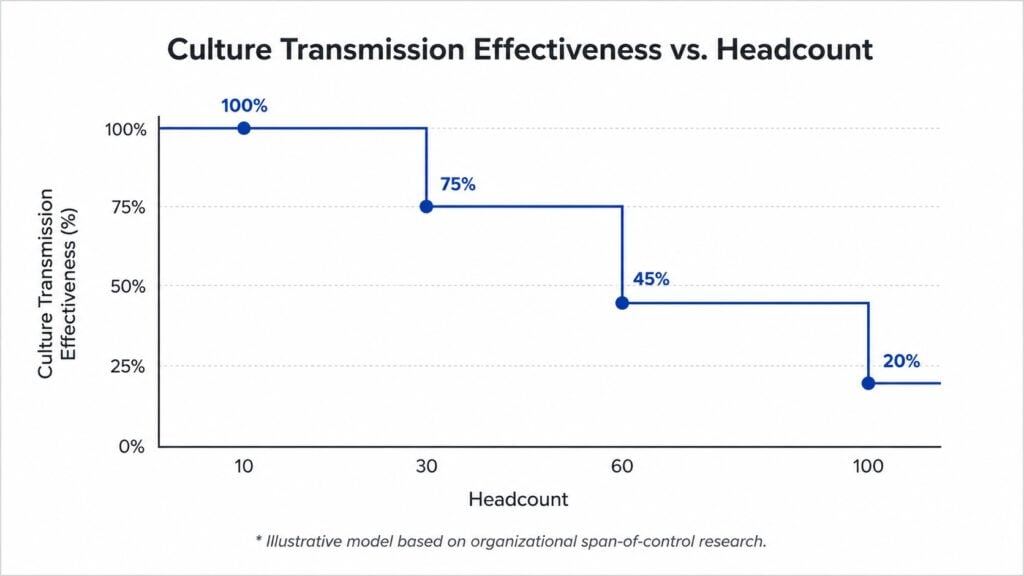
Most advice frames this as protecting culture: guard it, preserve it, don’t let it slip. That framing is backward-looking, and it gives you nothing to do on a Tuesday morning.
Culture at 10 people survives because transmission is automatic. Everyone hears the founder explain a decision, watches a mistake get handled, absorbs norms just by being in the room. That automatic transmission stops scaling around 30 people, and breaks further at 60 and again past 100. The fix isn’t protecting something fragile; it’s building a deliberate transmission system to replace the automatic one you’re outgrowing.
How Do You Identify Your Culture Carriers Before They Burn Out?
Every team has a handful of early or senior hires who informally transmit values, the people new hires actually learn “how we work here” from. Here’s the 3-step framework, starting with them.
Step 1: Name your culture carriers and check their capacity.
If the same three people are onboarding every new hire’s understanding of culture on top of their actual job, that’s a system with a single point of failure, usually already showing up as burnout in exactly those three people. (Related: if founder burnout is part of what’s driving this, our framework on when to step back covers the broader pattern.)
Step 2: Codify a small set of non-negotiable behaviors, in specific language.
Not “be authentic.” Something like “respond to customer escalations within two hours,” or “flag a blocked teammate in standup, don’t wait to be asked.” Keep the list to five behaviors max: a long list recreates founder-era rigidity, just distributed across more rules instead of one person.
Run each candidate behavior through this test before it makes the list:
- Would I actually performance-manage someone who consistently didn’t do this?
- Can a new hire observe this concretely, not just infer it from vibes?
- Is this tied to at least one reinforcement channel already?
- Would this still matter at 100 employees, or is it a 10-person-team habit?
- Does someone besides the founder currently model this?
A candidate that fails more than one of these is aspirational, not non-negotiable. Leave it off the list.
Step 3: Build a reinforcement channel for each behavior.
A codified behavior with no reinforcement channel is just a document nobody reads twice. Tie each one to something concrete: the hiring rubric, public recognition, a review criterion. What gets rewarded is what people believe, regardless of what the onboarding deck says. (If org structure is also part of the strain, our COO decision framework covers the adjacent operational-scaling question.
What Are the Most Common Culture-Scaling Mistakes, and What Do They Cost?
Four patterns show up repeatedly once you know what to look for:
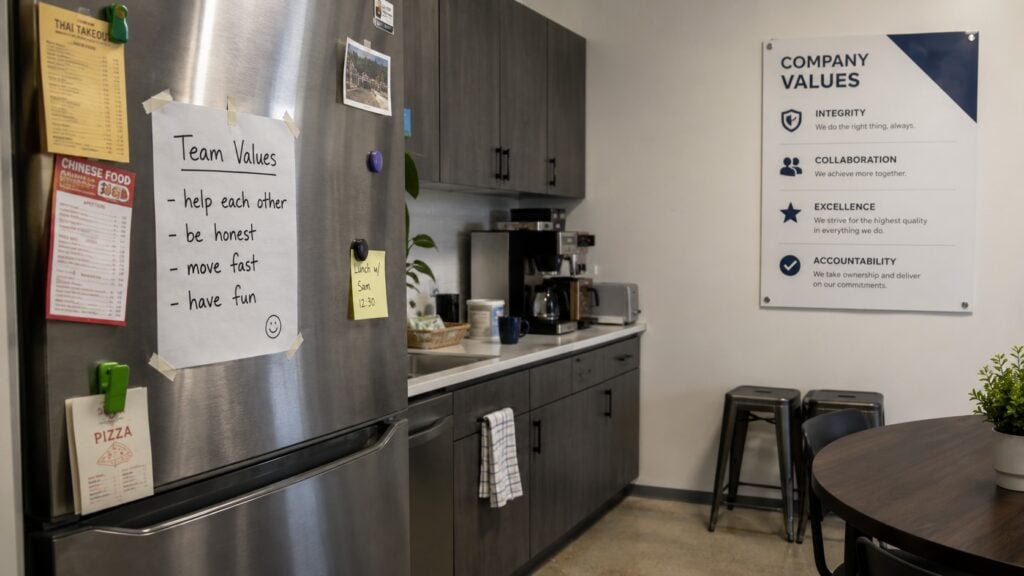
- A values poster with no behavioral teeth. “Integrity,” “excellence,” on a wall, tied to no actual decision. Cost: new hires nod along in onboarding and forget it by week two.
- Hiring for culture fit as a vibe check. Selects for sameness, not the specific behaviors that matter. Cost: a homogenous team that still doesn’t share the behaviors you need.
- Waiting for attrition to notice drift. Culture problems in exit interviews are already six months old. Cost: you’re rebuilding, not maintaining.
- Outsourcing onboarding content entirely. Generic HR boilerplate. Cost: new hires get compliance training, not culture, and fill the gap with old habits.
What Should You Do in the Next 24 Hours, 7 Days, and 30 Days?
Here’s the sequence, broken into three time horizons so it’s actionable starting today.
- Next 24 hours: Name your current culture carriers and estimate how much of the transmission load sits on them alone.
- Next 7 days: Draft your five non-negotiable behaviors in specific, observable language. Run each through the checklist above.
- Next 30 days: Build one reinforcement channel, hiring rubric, recognition system, or review criteria, for each behavior.
Real Numbers: What Does Culture-Driven Attrition Actually Cost?
Here’s the math, using a sourced range instead of a rough estimate.
Assumptions: SHRM puts the cost of replacing a salaried employee at 50–200% of their annual salary, depending on role and seniority. Using a $90,000 mid-level hire and a conservative 75% replacement-cost estimate within that range:
- Replacement cost per departure: ~$67,500
- Codifying five behaviors and building reinforcement channels: a few hours of leadership time plus rubric/review updates, a rounding error against a single avoided departure
- If culture drift is costing 2–3 preventable early departures a year, avoided cost runs $135,000–$202,500 annually
What breaks the math: Codifying behaviors that never make it into actual hiring panels or review criteria. The cost repeats every cycle if the reinforcement step gets skipped.
This article may contain affiliate links. CEO Journal may earn a commission if you purchase through one of these links. This never influences our editorial coverage.
Frequently Asked Questions
How is this different from just hiring for culture fit?
Culture fit hiring is a filter at the door. This framework is a transmission system for everyone already inside, including people hired before there was a system at all.
What if my non-negotiable behaviors change as we grow?
Review them, don’t constantly rewrite them. Revisit at each headcount threshold (30, 60, 100), not every quarter.
Isn’t codifying behaviors just corporate bureaucracy?
Only if the list is long. Five specific, observable behaviors with real reinforcement channels is closer to a decision-rights document than a policy manual.
What’s the fastest sign culture is already cracking?
Subcultures forming by function, each developing unwritten norms that don’t match what leadership assumes is happening company-wide.